Poznań’s Berdychowskie Bridges have received the Jan Baptysta Quadro Award, recognising a project that has reshaped connections across the Warta River and opened up new ways to explore the city. Two other recent developments, the restored Dom Książki and the redesigned courtyard outside Zamek Culture Centre, were also honoured in this year’s competition.
The winners were announced at a ceremony held at the Faculty of Architecture of Poznań University of Technology, marking the 28th edition of the city’s established architecture prize.
The awards celebrate buildings and public spaces that contribute to Poznań’s urban landscape, with this year’s selection highlighting the value of thoughtful design in both major infrastructure projects and smaller interventions in the city centre.
Berdychowskie Bridges take the top prize
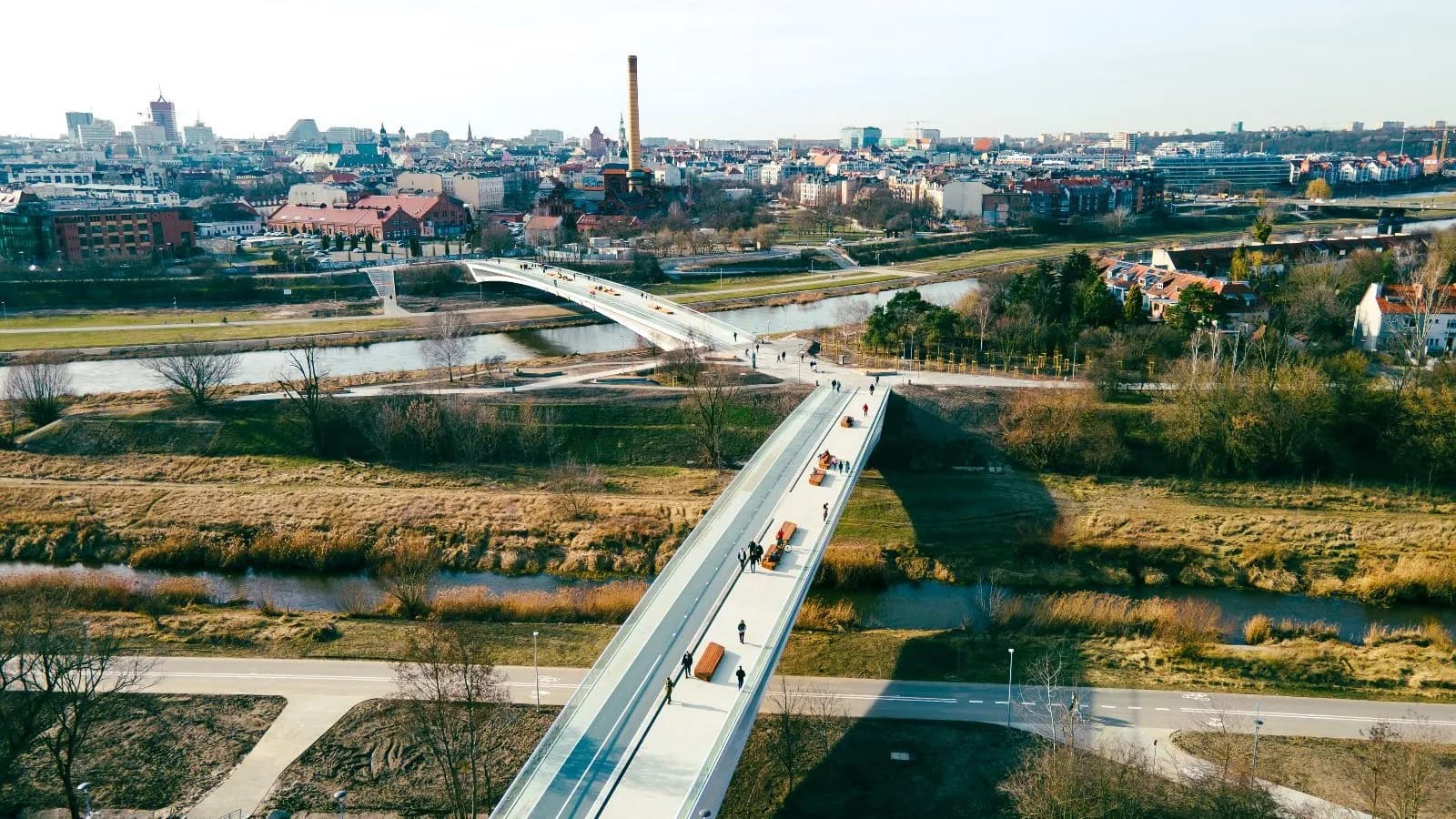
The main award went to SKI STUDIO, led by architect Błażej Szurkowski, for the Berdychowskie Bridges. The design team also included Bartosz Gurawski of ARPA Jerzy and Bartosz Gurawski, Maciej Sokolnicki of MS86A and Adam Turczyn of Foolscap. The structural design was undertaken by Jerzy Niewczas of PONTES.
The jury praised the bridges for improving connections between the two banks of the Warta and linking the Old Town more effectively with Ostrów Tumski and the Poznań University of Technology campus.
The project has created a new route for people moving between these parts of the city, while offering a riverside setting for walking, leisure and taking in views of Poznań from a different perspective.
In its assessment, the jury highlighted how the bridges had become an attractive public space in their own right, rather than serving solely as a river crossing. Their design was also recognised for its light appearance, careful detailing and considered use of lighting and street furniture.
The result is a distinctive addition to Poznań’s changing skyline and an increasingly familiar feature of the city’s riverside landscape.
Dom Książki earns first-degree distinction
The first-degree distinction went to Litoborski + Marciniak Biuro Architektoniczne for the redevelopment and extension of Dom Książki at 13A Gwarna Street. Architects Piotr Litoborski and Piotr Marciniak represented the practice.
The building holds a particular place in Poznań’s architectural and cultural identity, but had gradually deteriorated over the years. Its restoration was recognised as a significant undertaking, requiring the team to address complex conservation, technical and functional challenges alongside a demanding administrative process.
The jury also highlighted the treatment of the ground floor and basement, designed to make these areas more accessible to the public, and the introduction of residential accommodation.
These changes form part of the wider effort to revitalise central Poznań, giving an existing building a renewed role in the life of the city while retaining its local significance.
The recognition reflects the challenges involved in bringing older urban buildings back into use, particularly where conservation requirements must be balanced with contemporary expectations.
Zamek Culture Centre courtyard receives second distinction
The second-degree distinction was awarded to architect Aleksander Wadas for the Open Courtyard in front of Zamek Culture Centre at 80/82 Święty Marcin.
The redesigned space replaces a former car park with a more welcoming public setting, incorporating greenery and measures intended to accommodate people with reduced mobility.
The jury praised the project for responding to the needs of a broader range of users while introducing planting that provides a clear contrast to the previously paved parking area.
The design also reflects wider changes in how public spaces are planned, with greater attention to accessibility, demographic shifts and the effects of climate change.
Situated outside one of Poznań’s best-known cultural institutions, the courtyard offers an opportunity to improve the experience of arriving at and spending time around the centre, whether visiting an exhibition, attending an event or simply passing through the area.
Architecture designed for everyday city life
Natalia Weremczuk, Poznań’s Deputy Mayor, said the winning and recognised projects demonstrated how architectural quality could be achieved across different types and scales of development.
This year’s Jan Baptysta Quadro Award demonstrates that high-quality architecture in Poznań can take shape across a wide range of scales and functions. Both the winning Berdychowskie Bridges and the recognised Dom Książki and Open Courtyard in front of Zamek Culture Centre are the result of considerable effort and the designers’ meticulous craftsmanship.
As a result, these developments have not only fitted well into the existing urban fabric, but above all serve a social purpose. They create attractive spaces for residents, revitalise their surroundings and encourage people to meet.
Her comments reflect a common thread running through this year’s awards: the emphasis on how architecture functions beyond the individual structure or design.
The bridges improve movement between neighbourhoods and destinations, Dom Książki brings a deteriorating building back into active use, and the Zamek courtyard reconsiders how public space can serve pedestrians and visitors.
Together, the projects demonstrate several approaches to improving the city, from major infrastructure investment to the careful renewal of familiar central locations.
A long-standing award for Poznań architecture
The Jan Baptysta Quadro Award is one of Poland’s longest-established architectural distinctions. Presented since 1999, it recognises outstanding buildings and developments designed and completed in Poznań and opened to the public in the year preceding each competition edition.
The award is named after Jan Baptysta Quadro, the Renaissance architect associated with the reconstruction of Poznań Town Hall on the Old Market Square.
Entries are assessed by a panel comprising representatives of the organisers and specialists in architecture and urban planning. The criteria include spatial quality, functionality, construction standards, relationships with the surrounding area and the impact of each project on the urban landscape.
This year’s results recognise three different ways of shaping the city: connecting its riverbanks, preserving and adapting an important building, and creating a greener, more accessible public space.
See more: A Season for Art: What’s Showing in Poznań This Autumn