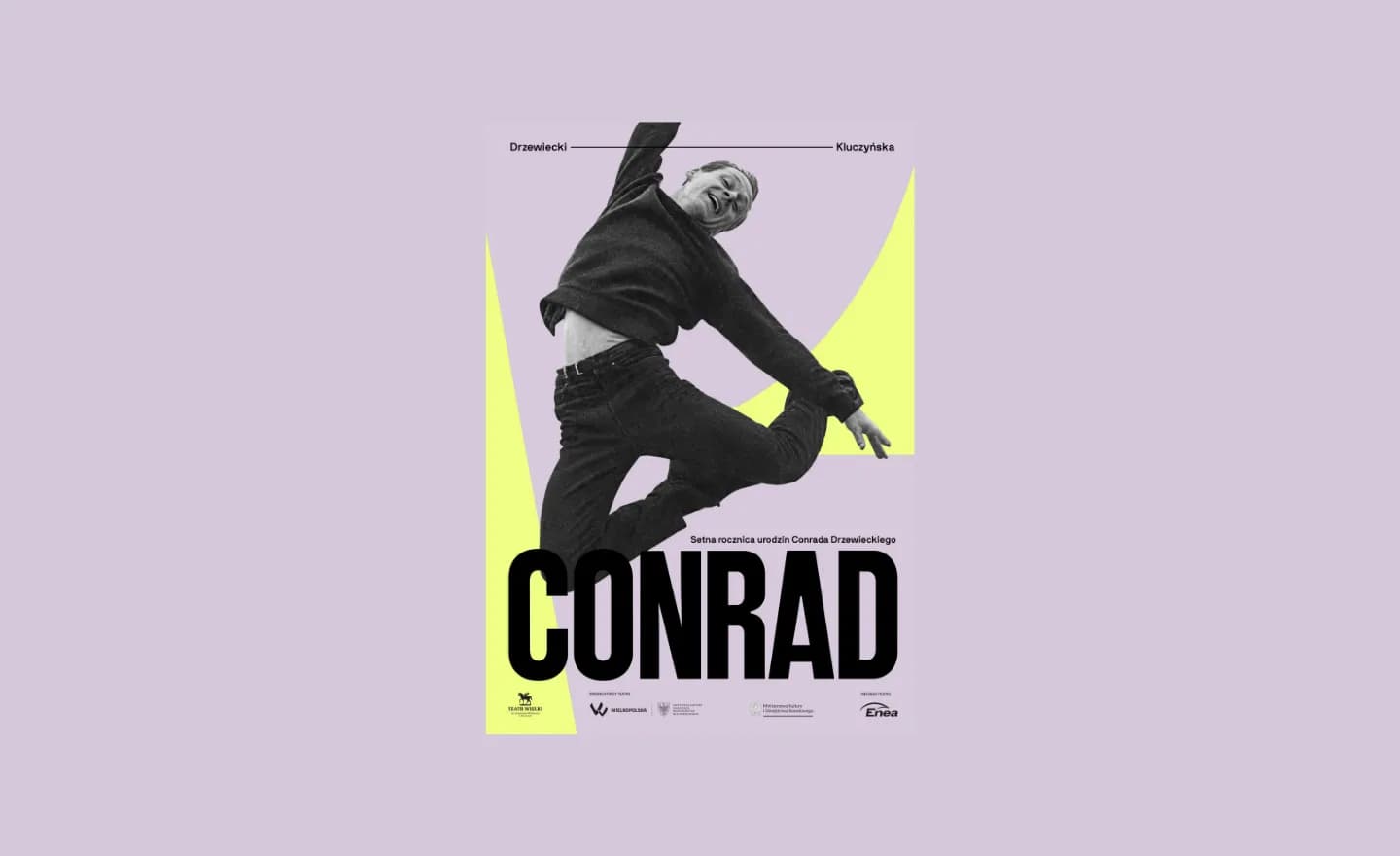
Teatr Wielki in Poznań is marking the 100th anniversary of Conrad Drzewiecki’s birth with a programme devoted to four of the choreographer’s best-known works.
Drzewiecki was one of the defining figures in 20th-century Polish dance. His career was closely tied to Poznań, where he began as a soloist and later reshaped the city’s ballet scene as a choreographer, artistic director and teacher.
The centenary programme brings four of his choreographies back to the stage under the Pegaz: Etiuda b-moll, Adagio, Krzesany and Odwieczne pieśni. They draw on very different musical worlds, from Karol Szymanowski and Tomaso Albinoni to Wojciech Kilar and Mieczysław Karłowicz.
The performances feature the Ballet and Orchestra of Teatr Wielki in Poznań, with the premiere scheduled for Wednesday, 14th of October.
Four works from Drzewiecki’s repertoire
The programme offers a useful snapshot of Drzewiecki’s approach to choreography and the range of influences that shaped his work.
Szymanowski’s Etiuda b-moll moves away from the conventional idea of an étude as simply a technical exercise. Its lyrical character and melancholy atmosphere provided Drzewiecki with material for a choreography that pushed ballet towards a more contemporary visual language.
Adagio, set to music by Tomaso Albinoni, takes a much more restrained approach. Its sparse movement and concentrated atmosphere place the dancers' physical presence at the centre of the work.
There is a sharp change of energy with Wojciech Kilar’s Krzesany. Drzewiecki brought elements of highland dance into a modern ballet vocabulary, including the distinctive heel strikes associated with the traditional dance. The result became one of his most recognisable choreographic works.
The programme also includes Odwieczne pieśni, set to Mieczysław Karłowicz’s symphonic poem. Here, Drzewiecki used relatively economical movement to create a work shaped as much by atmosphere and imagery as by narrative.
Taken together, the four pieces illustrate the breadth of his choreographic language, from classical technique and contemporary movement to Polish folk traditions.
A Poznań career that changed Polish dance
Drzewiecki was born in 1926 and began his professional career as a soloist with what was then the Opera Poznańska.
After performing internationally, including in France and Italy, he returned to Poland in 1963 and took charge of the ballet at the Poznań opera. It was during this period that he developed a series of ambitious choreographies and became an increasingly influential figure in Polish dance.
He later became artistic director of the State Ballet School in Poznań and, in 1973, founded the Polish Dance Theatre.
The company allowed Drzewiecki to develop a distinctive approach that brought contemporary dance into dialogue with classical ballet and Polish folklore. Under his direction, the Polish Dance Theatre performed at festivals and on international tours, helping to establish Poznań as an important centre for contemporary dance.
In the city today, his legacy is particularly visible through the institutions and artistic traditions that followed his work.
Drzewiecki through the archive
The centenary programme extends beyond the theatre itself. From 1st of October, the Poznań Photoplasticon at 44 F. Ratajczaka Street is hosting Na scenie. Conrad Drzewiecki i Teatr Wielki w Poznaniu - z archiwum.
The exhibition brings together photographs, notes and theatre posters connected with Drzewiecki and his work at the theatre. Some of the photographs have not been publicly shown for many years.
The material has been reconstructed using analogue three-dimensional technology, making the Photoplasticon a fitting setting for an exhibition concerned with movement, performance and memory. The photographs are by Grażyna Wyszomirska.
The exhibition runs until 30th of November, giving visitors several weeks to explore the archival material alongside the October performances.
See more: Czech Culture Days in Poznań: Literature, Theatre and Exhibitions