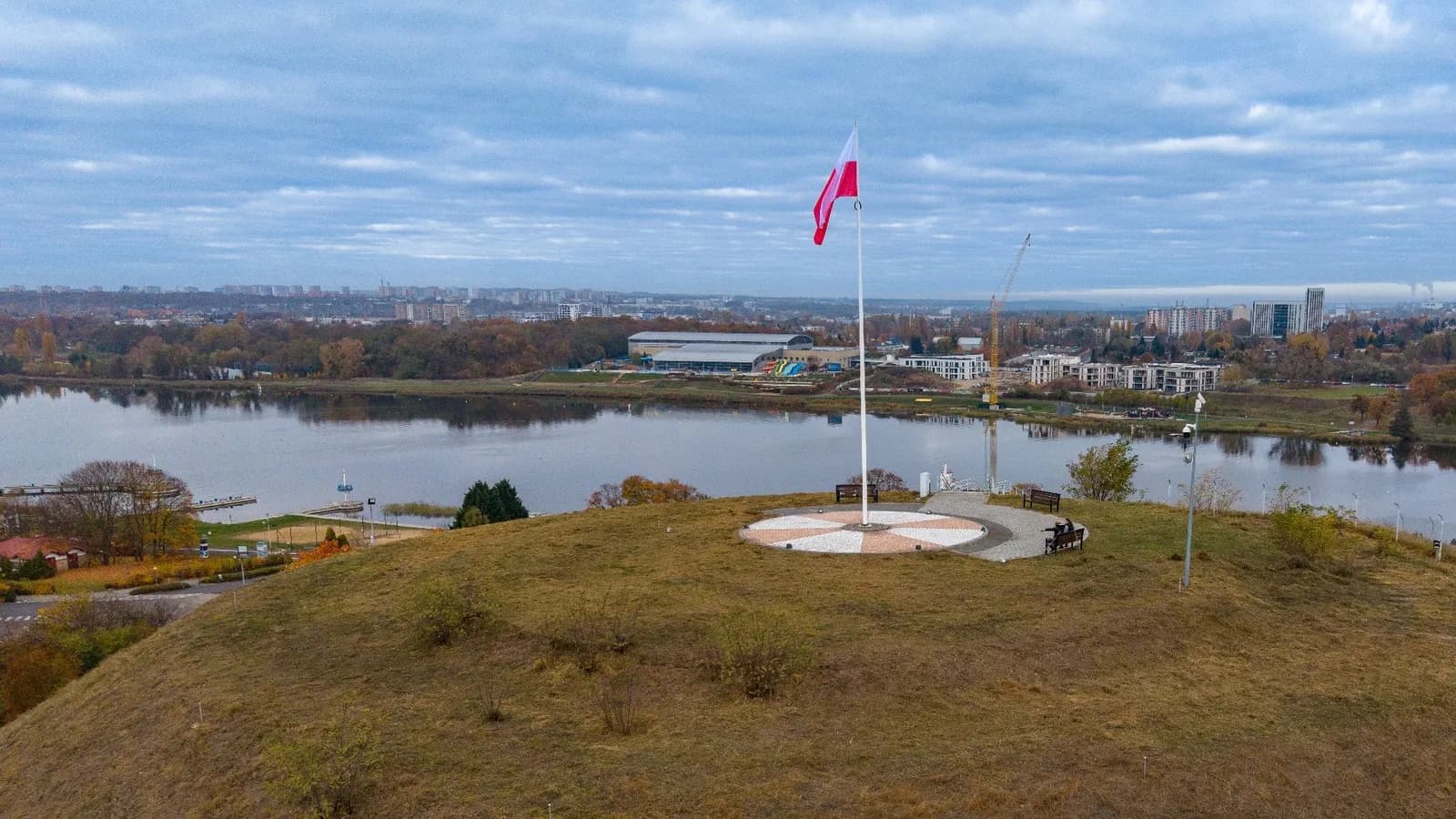
Poznań’s Freedom Mound (Kopiec Wolności), overlooking Lake Malta, will open to visitors on Wednesday, 11th November, as part of the city’s celebrations marking Poland’s Independence Day.
The Poznań Sports and Recreation Centres (POSiR) have confirmed that the mound will be accessible between 10:00 and 16:00, giving residents and visitors an opportunity to climb to its summit and explore one of Poznań’s distinctive historical landmarks.
Access will be managed in groups, as a maximum of 20 people can be on the summit at any one time. Visitors should therefore be prepared to wait during busier moments.
A monument built through local effort
The history of the Freedom Mound is closely connected to Poznań’s recovery of independence and the Greater Poland Uprising (Powstanie Wielkopolskie).
Construction of the original mound began on 3rd May 1919, just months after Poland regained independence and the successful Greater Poland Uprising. The project was a community initiative, financed through public donations in the form of special contribution tokens (cegiełki). Residents took part in the physical work themselves, gathering in the afternoons to carry earth and gradually build the mound.
It took three years to complete. However, during the Second World War, the German occupying forces destroyed the structure, using Jewish people and prisoners of war to carry out the work.
The idea of rebuilding the mound returned in the 1980s, when Lake Malta was being prepared for the 1990 World Canoe Championships. Although the communist authorities did not officially approve its reconstruction, the earth excavated during work on the lake provided a practical opportunity to recreate the hill. The official explanation was that it formed part of the development of Malta as a sports and recreation area.
The rebuilt mound became a lasting feature of the landscape around Lake Malta.
Modernisation marked Poland’s centenary of independence
In 2018, marking 100 years since Poland regained independence, the Freedom Mound underwent significant modernisation and was officially reopened.
The improvements included repairs to the western access path leading to the summit and the northern viewing platform, together with new stone paving. A foundation for a flagpole was constructed at the top, while new lighting and illumination made the mound more visible after dark.
An information board was also installed near the entrance, explaining the monument’s history and symbolism.
The reopening ceremony was attended by representatives of the city, members of parliament, university rectors, veterans' organisations and Poznań residents. The ceremony was led by Mariusz Wiśniewski, who was the Deputy Mayor of Poznań at the time.
Speaking at the time, Wiśniewski highlighted the importance of restoring the landmark as part of the city's commemorations:
“I am pleased that we have managed to achieve our goal and restore this site to the city landscape on the 100th anniversary of Poland regaining independence and the outbreak of the Greater Poland Uprising. This initiative has a social and patriotic dimension. It refers to an initiative launched by the residents of Poznań in 1919.”
Why the mound is not open throughout the year
Despite its public significance and prominent position beside Lake Malta, the Freedom Mound is not permanently accessible to visitors.
During the 2018 modernisation, geodetic monitoring points were installed to help determine whether the structure was experiencing ground settlement or deformation. Its stability remains an important consideration when deciding when the site can safely accommodate visitors.
Explaining the restrictions, POSiR spokesperson Filip Borowiak told Głos Wielkopolski:
“The restriction on the number of people allowed on the summit at any one time results from safety requirements and the need to protect the stability of the mound. The site is susceptible to ground settlement and deformation. This is why we make the mound accessible only on selected days.”
The 20-person limit on the summit will also apply during this year's Independence Day opening, with visitors admitted in groups.
Sources: gloswielkopolski.pl, posir.poznan.pl, poznan.pl