Every November, the familiar sight of St Martin’s croissants returns to Poznań. Bakery windows fill with the golden, crescent-shaped pastries, and the smell of freshly baked dough and sweet poppy seed filling becomes part of the city’s autumn atmosphere.
The famous rogale świętomarcińskie have become one of Poznań’s best-known specialities, with a protected European designation and a tradition stretching back more than a century.
Yet there is another local sweet worth looking out for. Poznań’s rury are crisp, honey-flavoured biscuits with an equally interesting history, although they remain far less familiar outside the region.
Together, these two treats tell different stories about the city’s baking traditions, from charitable celebrations and skilled confectionery to church fairs and seasonal street markets.
St Martin’s croissants: 92 producers receive certification
The annual preparations for St Martin’s Day bring an important reminder for anyone planning to buy an authentic Poznań croissant: not every crescent-shaped pastry sold under a similar name is a certified rogal świętomarciński.
This year, 92 bakeries and confectioners in Poznań and the Wielkopolska region have received certificates confirming that their products meet the requirements for traditional St Martin’s croissants. Inspections at four additional establishments are still under way.
The certification process begins when a bakery or confectionery submits a formal application for an official inspection to the Regional Inspectorate for Commercial Quality of Agricultural and Food Products (WIJHARS).
Once the product has passed the inspection and meets the official specification, the producer receives a quality certificate. Following the first inspection, it is valid for one year. Subsequent certifications can remain valid for up to three years, with unannounced inspections possible during that period.
The Poznań Guild of Confectioners and Bakers (Cech Cukierników i Piekarzy) also issues an annual decorative certificate, usually around November. This provides customers with a visible indication that the bakery is authorised to produce the traditional speciality.
The Guild website provides a handy map with all certified bakeries in and around Poznań.
What makes a genuine St Martin’s croissant?
Since 2008, the traditional St Martin’s croissant has been recognised by the European Union as a Protected Designation of Origin (PDO) product.
This means that its production is tied to a specific geographical area and an officially defined method of preparation. The designation protects the name and helps preserve the traditional recipe.
The characteristic flavour comes from the combination of a layered, flaky pastry and a rich white poppy seed filling. The filling contains white poppy seeds, sugar, crumbs, egg mixture, fat, raisins, nuts, fruit in syrup or candied fruit, and almond flavouring.
The pastry is rolled and folded to create its distinctive layers before being filled, shaped into a crescent and finished with icing and chopped nuts.
There are also requirements concerning its size. A traditional St Martin’s croissant should weigh no more than 250 grams.
Although the recipe is not secret, getting the balance of pastry and filling right requires considerable skill. Certified producers receive a copy of the specification with their documentation, and the recipe is also available through the Poznań Guild of Confectioners and Bakers.
A tradition born from an act of generosity
The story of St Martin’s croissants is closely connected to the city’s charitable traditions.
According to the familiar Poznań account, the custom dates back to 1891, when Father Jan Lewicki, parish priest of St Martin’s Church, encouraged local residents to follow the example of St Martin by helping people in need.
A Poznań confectioner, Józef Melzer, was the first to respond. He encouraged wealthier residents to buy croissants, while those who could not afford them received the pastries for free.
The money raised helped provide food assistance for Poznań’s poorest residents in the run-up to Christmas Eve.
In 1901, the Association of Confectioners took over the baking tradition, helping establish the custom that continues today.
The scale of production is now considerable. Members of the Poznań Guild of Confectioners and Bakers sell an average of 250 tonnes of St Martin’s croissants on 11 November alone. Across the entire year, their production reaches approximately 500 tonnes, or around 2.5 million croissants.
The pastries have also travelled beyond Wielkopolska. In recent years, Poznań has organised promotional activities in other Polish cities, combining the distribution of croissants with a message about kindness and community spirit.
The tradition remains particularly visible during the celebrations surrounding 11th November, when St Martin’s Street becomes the centre of the city’s festivities.
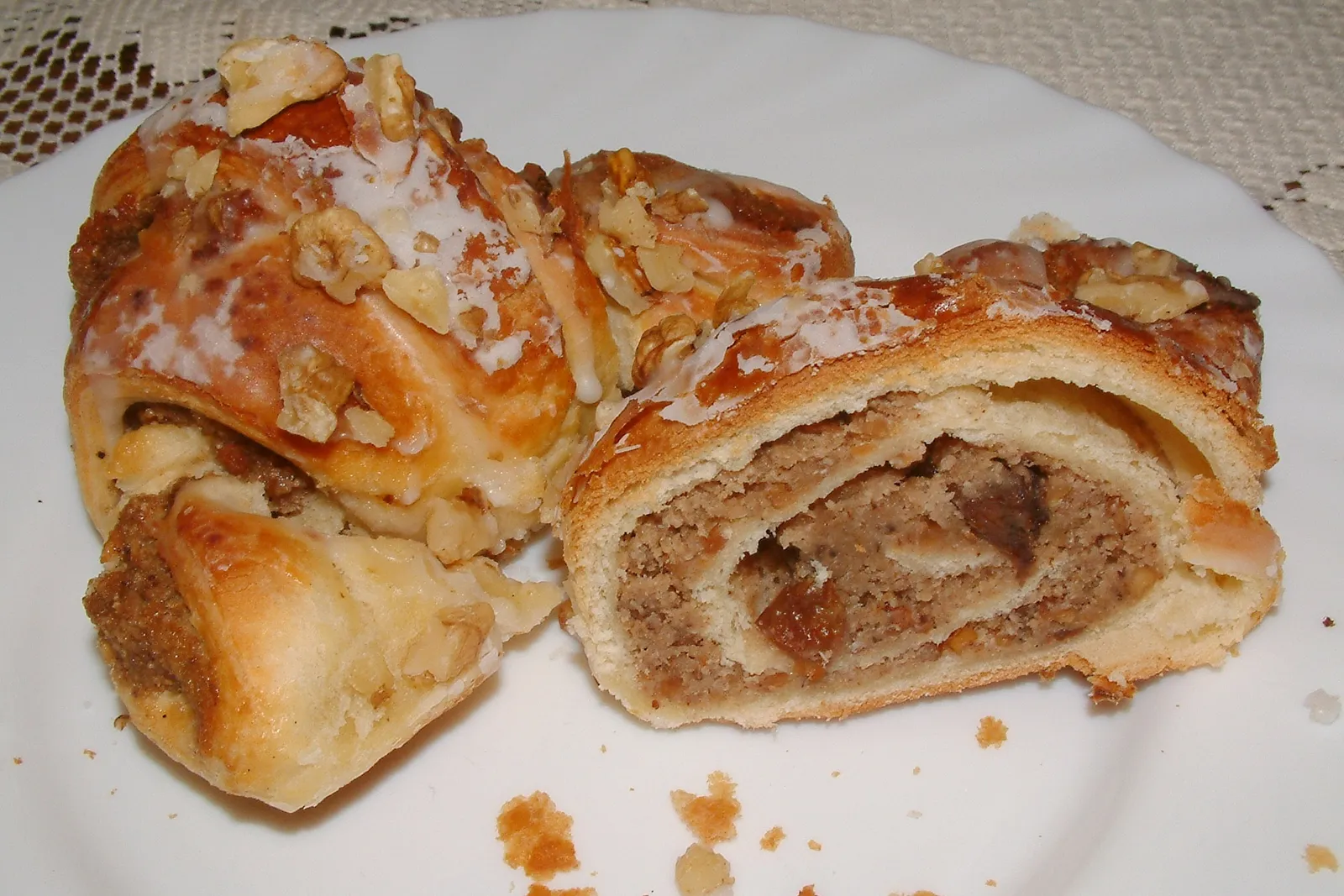
Poznań’s rury: the honey biscuits you might have missed
While St Martin’s croissants attract queues outside bakeries, another traditional Poznań sweet tends to appear more quietly, often on seasonal market stalls rather than in confectionery shop windows.
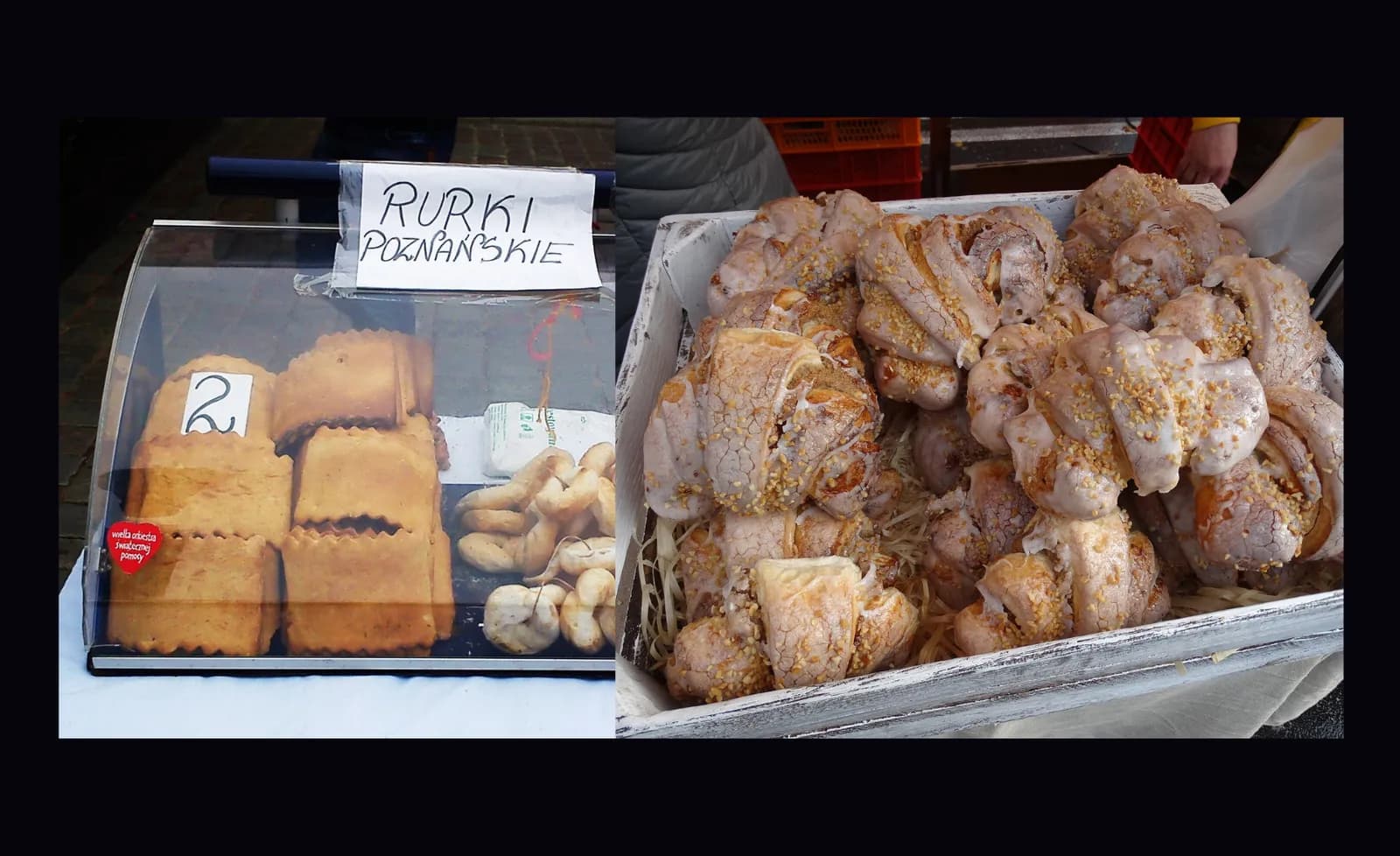
Known as rury, and historically also called trąby or dachówki, these are hard, crunchy biscuits with a distinctive honey flavour.
They are made primarily from flour, sugar and honey. Some traditional recipes also use honeydew honey or caramel, although exact proportions and preparation methods vary between local producers.
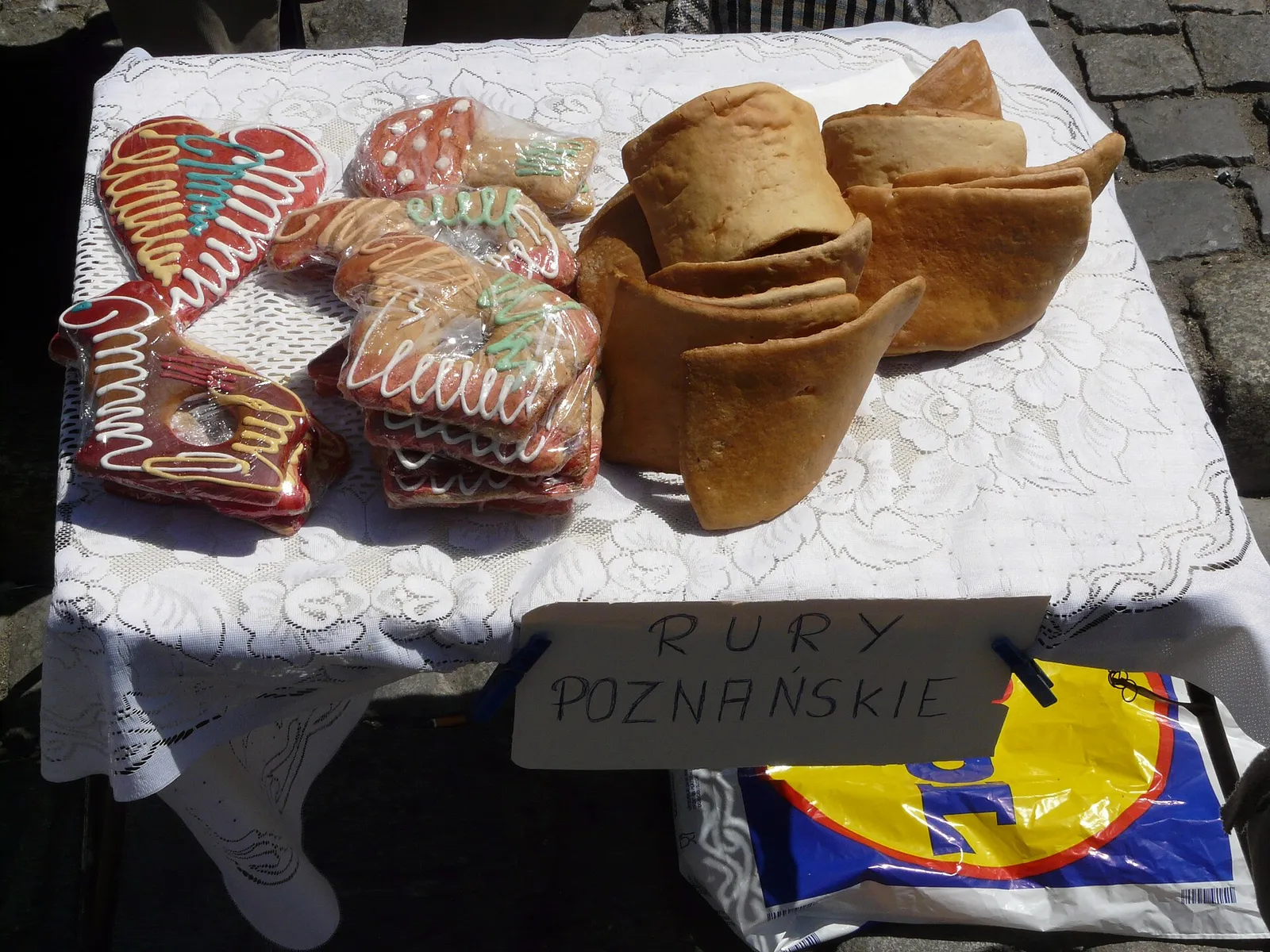
Unlike the croissant, rury are not generally available throughout the year. Their appearance is closely associated with religious celebrations, traditional fairs and particular times in the local calendar.
For generations, they were sold during Pentecost and the eight-day celebration following Corpus Christi. Sellers carried them in wicker baskets lined with white cloth, creating a familiar sight at church fairs and local festivities.
Today, one of the easiest times to find rury is in autumn, particularly in the days leading up to All Saints’ Day on 1st November. Stalls near Poznań’s cemeteries often sell the biscuits alongside other seasonal sweets.
They also make appearances at outdoor events, including the St John’s Fair (Jarmark Świętojański).
For many, spotting rury at an autumn market is part of the familiar seasonal landscape of Poznań.
Where does the name rury come from?
The origins of the name remain uncertain, but there are several explanations.
One popular theory links it to the way the biscuits were traditionally shaped. According to this account, freshly baked, still-warm pieces of dough were bent around hot oven pipes, giving them their characteristic curved form. The Polish word rury means pipes or tubes.
Another explanation traces the name back to trąby, an older term used for the sweets during the interwar period. Over time, the name is believed to have evolved into rury.
There is also a local legend connecting the biscuits to the Corpus Christi celebrations.
According to one version, an orchestra playing during a religious procession was so loud that roof tiles began falling from nearby buildings. Nuns supposedly commemorated the incident by making biscuits resembling the damaged roof tiles, giving rise to the alternative name dachówki.
Two symbols of Poznań’s food heritage
St Martin’s croissants and rury occupy different places in the city's culinary calendar, but both reflect the importance of food in Poznań’s local traditions.
One has become an internationally recognised regional speciality, protected by European regulations and produced in substantial quantities by certified bakeries. The other remains a more modest seasonal treat, associated with traditional fairs, religious holidays and the familiar sight of autumn market stalls.
The next time you buy a St Martin’s croissant, look for the official certification and remember the charitable story behind the November tradition. And if you come across a stall selling rury near one of the city’s cemeteries or at a local fair, consider trying a few.
The croissant may be Poznań’s most famous sweet, but the humble honey biscuit deserves a place on the city's culinary map too.