Poznań has its own way of speaking, from calling a dog a kejter to ordering a szneka z glancem at the bakery. Now, a new AI project developed by master’s students at Adam Mickiewicz University (AMU) is giving the city’s distinctive dialect a place in the digital world.
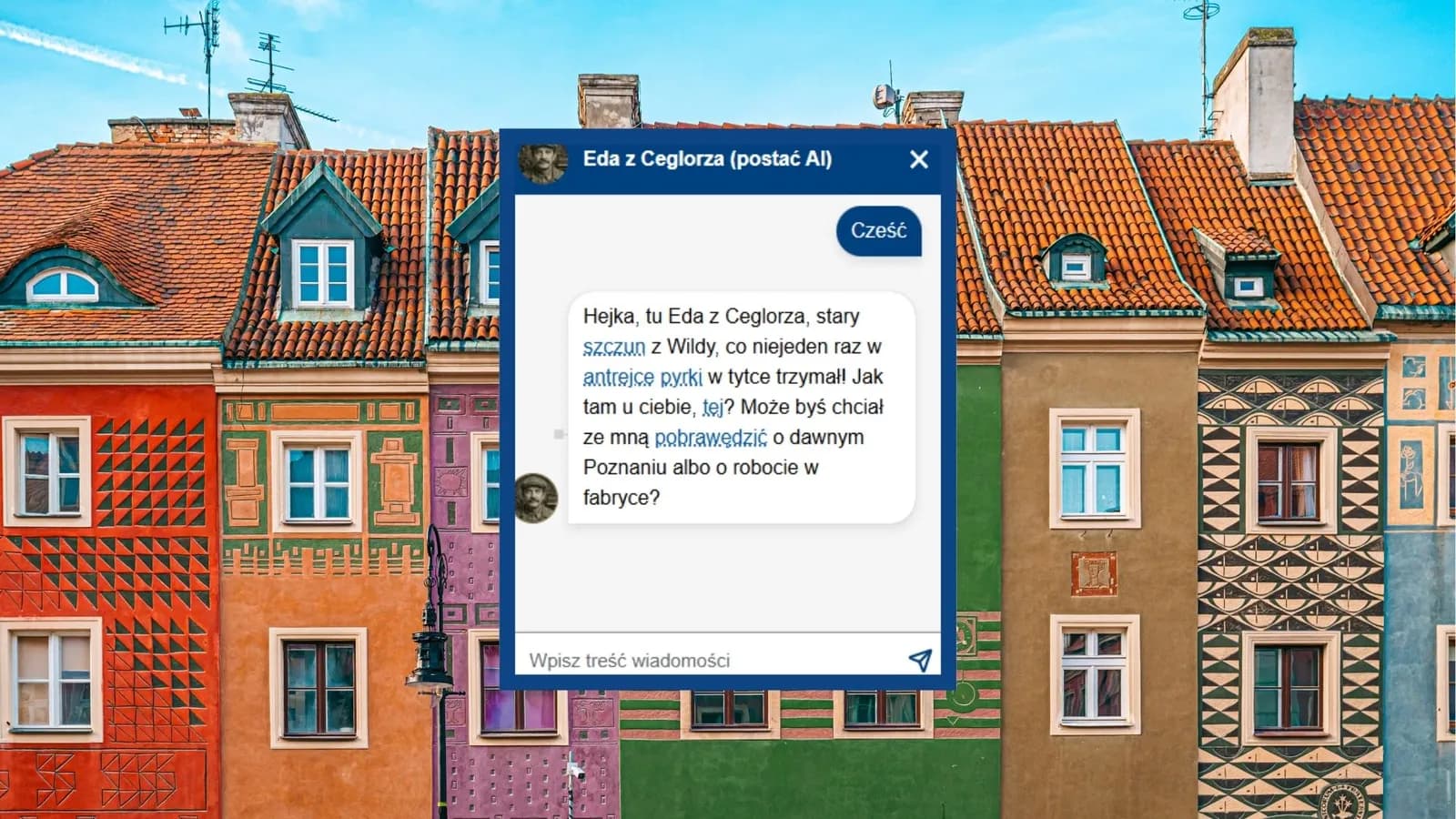
Called Tej Aj, the project allows users to chat in gwara poznańska, the dialect of Poznań. Its conversational character, Eda z Wildy, is a fictional worker at the city’s historic Cegielski factory, known locally as Ceglorz.
The idea is simple: make the language of Poznań accessible through an everyday activity that feels natural to younger generations. Rather than learning unfamiliar words from a list, users can explore the dialect by having a conversation.
Keeping local words in circulation
Poznań’s dialect is woven into the city’s identity. Words such as kejter (dog), bimba (tram), tytka (bag) and szneka z glancem (a sweet bun with icing) remain familiar to many residents, particularly those who grew up hearing them at home.
Yet, as everyday language changes between generations, some expressions risk becoming less common. Younger residents may encounter them through family stories, cultural activities or educational resources rather than in regular conversation.
The online Poznań Urban Dialect Dictionary has long helped document this vocabulary. Based on a publication first released in 1997, it contains thousands of entries, definitions and examples of local usage.
Tej Aj is intended to build on that work. New words encountered through conversations with the chatbot are expected to contribute to the dictionary, helping to expand the record of how Poznań’s dialect is used.
For a language shaped by the city's streets, workplaces, family homes and neighbourhoods, the opportunity to keep its expressions in active use is particularly valuable.
A university project combining technology and local knowledge
Tej Aj was developed at AMU’s Faculty of Mathematics and Computer Science as a research and development project involving four master’s students.
The team also worked with dialect specialists from the university, the Poznań Heritage Centre, AMU’s Artificial Intelligence Centre and AMUai, a university spin-off.
This collaboration brought together technical expertise and knowledge of the region’s language and cultural history. The aim was to explore whether modern AI models could support conversations in a local dialect, rather than simply reproduce a collection of traditional expressions.
Professor Krzysztof Jassem, director of AMU’s Artificial Intelligence Centre and the project’s academic supervisor, sees the initiative as an example of technology serving a cultural purpose:
Tej Aj is an example of innovation emerging at the intersection of new technologies and the humanities. What is particularly valuable is that artificial intelligence has been used not to automate processes, but to protect and promote local cultural heritage. Thanks to solutions like this, knowledge of Poznań’s language, traditions and history can be passed on to future generations of residents in an engaging way. It is also worth emphasising that this initiative came from representatives of the younger generation.
The involvement of students is an important part of the story. The project puts a contemporary tool in the hands of people who may not have grown up speaking the dialect, giving them another way to connect with the city's linguistic heritage.
Meet Eda, a fictional worker from Ceglorz
Eda z Wildy is designed to make the experience informal and entertaining. The character is a fictional employee of Ceglorz, a familiar local name for the historic Cegielski industrial factory workers.
The choice of character gives the chatbot a distinctly Poznań setting. Rather than presenting the dialect as a museum exhibit, Eda offers a conversational way to encounter local expressions and the cultural references behind them.
That approach could appeal to a broad audience, including residents who want to revisit words they remember from childhood, families introducing children to regional traditions, and international residents keen to understand the language they hear around them.
The project also offers a useful starting point for exploring the city's industrial past and neighbourhood identity, although the chatbot itself should be treated as an informal cultural resource rather than an authoritative historical guide.
Giving Poznań’s dialect a place online
Regional languages and dialects are passed on through ordinary conversation, and Tej Aj explores how that process might work when everyday exchanges increasingly take place through digital tools.
The project creates a fun new way to introduce local vocabulary to new audiences while complementing existing efforts to document the dialect. It also offers an accessible activity for residents and visitors who want to learn more about the character of the city.
The technology is still developing, and the chatbot is not intended to replace language specialists or established historical resources. Its value lies in inviting people to take an interest, try unfamiliar expressions and discover the stories carried by the words.
Anyone curious to give it a try can visit the Poznań Urban Dialect Dictionary, where Eda invites visitors to poblubrać, or have a chat, in the local dialect.