Walk through central Poznań today and you will pass through several centuries of architectural history within minutes.
A few steps from the colourful façades of the Old Market Square, the grand avenues of the Imperial District and the lively cafés of Święty Marcin Street, two very different buildings stand quietly above the city streets.
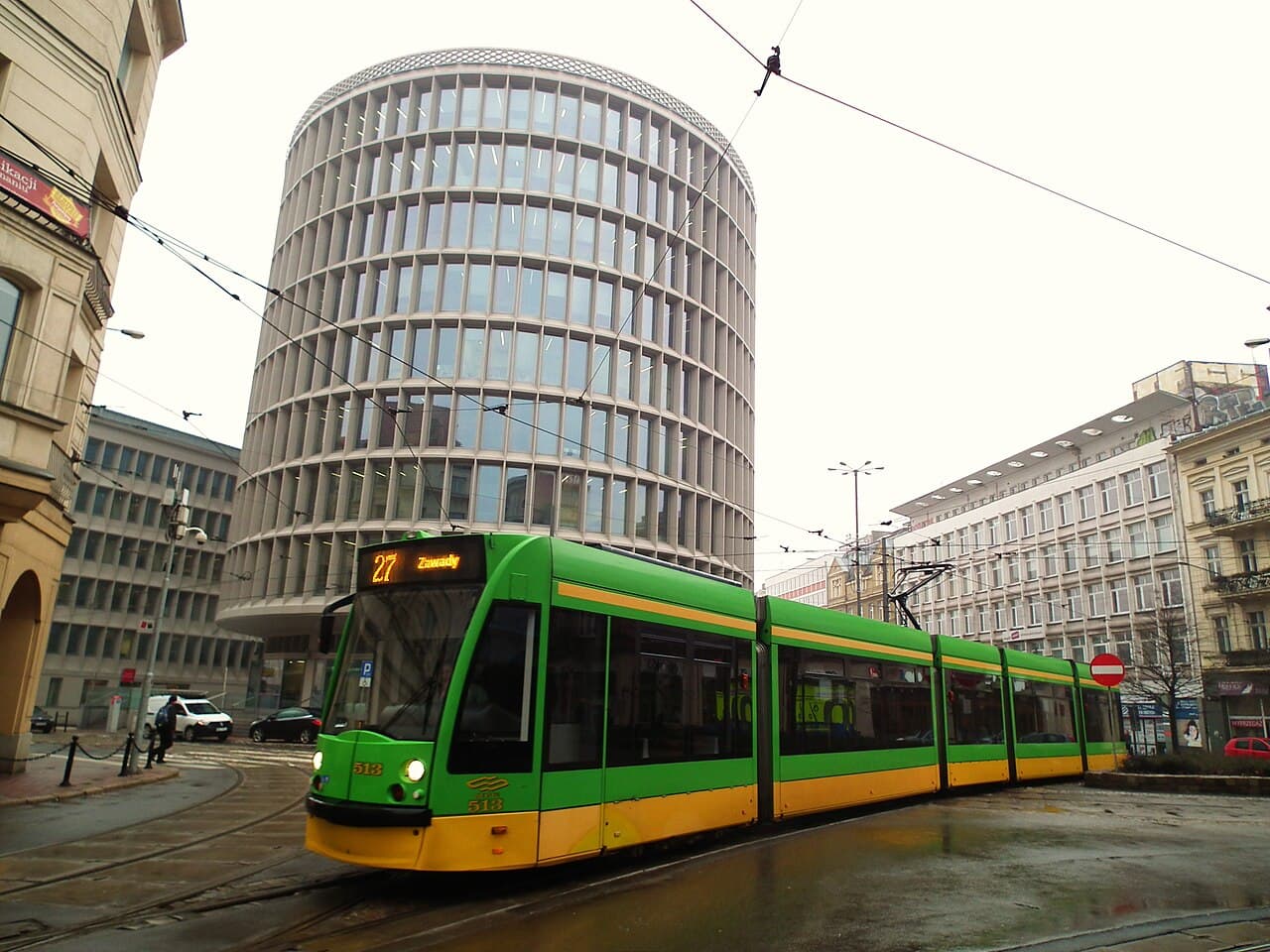
One is instantly recognisable: a perfectly rounded tower with a distinctive mid-century character. The other is more restrained, with straight lines and a practical appearance. Together, Okrąglak and Kwadraciak form one of Poznań’s most interesting modernist landmarks.
For many residents, these buildings are simply familiar parts of the city centre. They are meeting points, reference points and places passed on the way to work, university or the shops. Yet behind their everyday presence lies a fascinating story about post-war reconstruction, changing architectural ideas and Poznań’s search for a modern identity.
A City Rebuilding Its Future: Poznań After 1945
To understand why Okrąglak mattered, it is important to remember the condition of Poznań after 1945.
The city suffered extensive damage during the Second World War, particularly around the historic centre. After the war, architects and planners faced a difficult challenge: how should Poznań rebuild itself?
Some areas focused on restoring historic character, while others became places where architects experimented with new forms and materials.
Okrąglak emerged from this period of change. It represented a belief that the rebuilt city should not only recreate the past but also create something new.
The Round Building That Redefined Central Poznań
Designed by architect Marek Leykam, Okrąglak opened in 1955 and quickly became one of Poznań’s most recognisable buildings.
Its name comes from its unusual circular shape. In everyday Polish, “Okrąglak” means something like “the little round one”, a simple nickname that became part of the city’s vocabulary.
At a time when many buildings in Poland followed more traditional approaches, Okrąglak looked remarkably different. Its clean geometric form, vertical lines and unusual shape gave Poznań a landmark that felt connected to international modern architecture.
Originally opened as a department store, Okrąglak became a familiar part of everyday life. For generations of Poznań residents, visiting the building was not only about shopping. It was an experience connected with the atmosphere of the city centre.
The building represented something modern and optimistic: a place where people could encounter new products, new interiors and a new vision of urban life.
Inside Okrąglak: Where Architecture Becomes an Experience
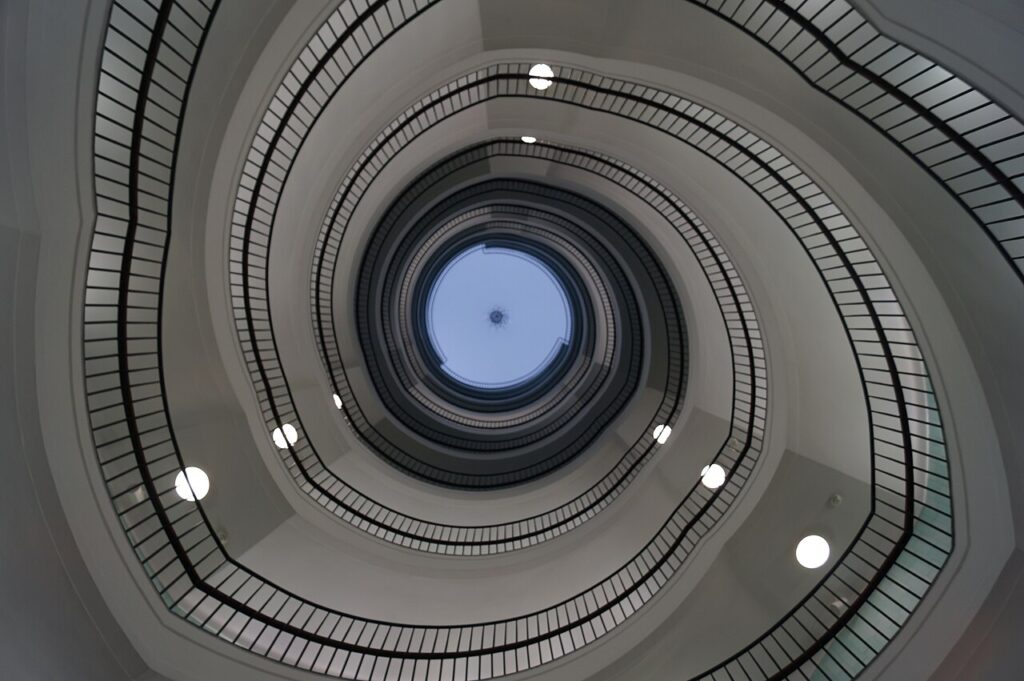
Although the exterior is what most people notice first, Okrąglak’s interior contains one of its most memorable features.
The central staircase creates a dramatic spiral movement through the building. Instead of treating stairs as a purely functional necessity, the design makes them part of the architectural experience.
Standing inside Okrąglak, visitors can understand why modernist buildings deserve attention. Their beauty often comes not from decoration, but from proportion, light, structure and carefully planned space.
From Department Store to Modern Office Building
Over the decades, Okrąglak’s role changed.
Like many buildings from the second half of the 20th century, it went through a period when modernist architecture was typically undervalued. Some people saw these buildings as outdated reminders of the communist era rather than important parts of urban heritage.
However, attitudes have changed. Across Europe, cities have increasingly recognised the importance of preserving significant examples of 20th-century design.
Okrąglak underwent a major renovation in the early 2010s, giving the building a new life while respecting its architectural character.
Today, it stands as an example of how older buildings can adapt to new purposes without losing their identity.
Meet Kwadraciak: The Square-Shaped Companion to Okrąglak
Just nearby stands another building with an equally local nickname: Kwadraciak.
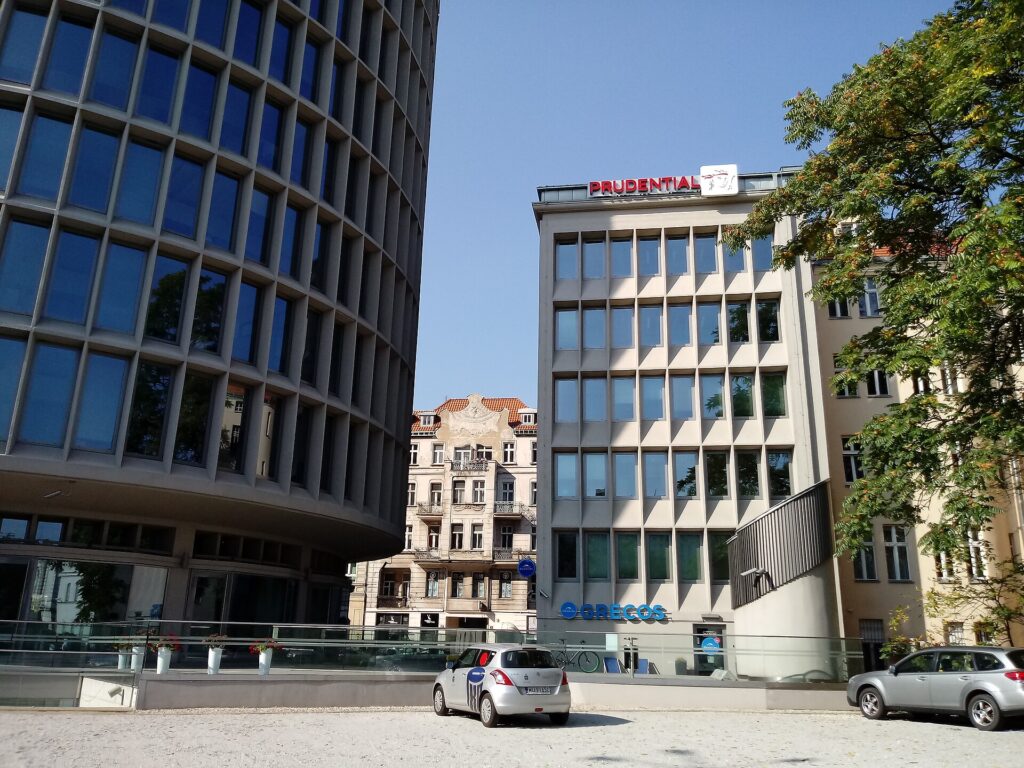
Completed in 1968, Kwadraciak takes an entirely different architectural approach. While Okrąglak is defined by its curves, Kwadraciak is based on straight lines, repetition and structure.
The name is a natural companion to Okrąglak as Kwadraciak translates into “The Square One”.
Together, the two buildings create a small but fascinating architectural conversation in the centre of Poznań.
Two Buildings, Two Visions
The relationship between Okrąglak and Kwadraciak is what makes this corner of the city particularly interesting.
They were created in different moments and represent different approaches to modern architecture.
Okrąglak represents:
- creativity and visual expression;
- a public building designed to attract attention;
- confidence in bold architectural ideas.
Kwadraciak represents:
- practicality and efficiency;
- the growing importance of office space;
- a more restrained version of modern design.
Standing between them, visitors can see how architectural priorities changed within just over a decade.
Another Side of Poznań’s Architecture
Poznań is often celebrated for its Renaissance Town Hall, historic churches and beautiful Old Market Square. These landmarks remain essential to understanding the city.
But buildings such as Okrąglak and Kwadraciak reveal another side of Poznań.
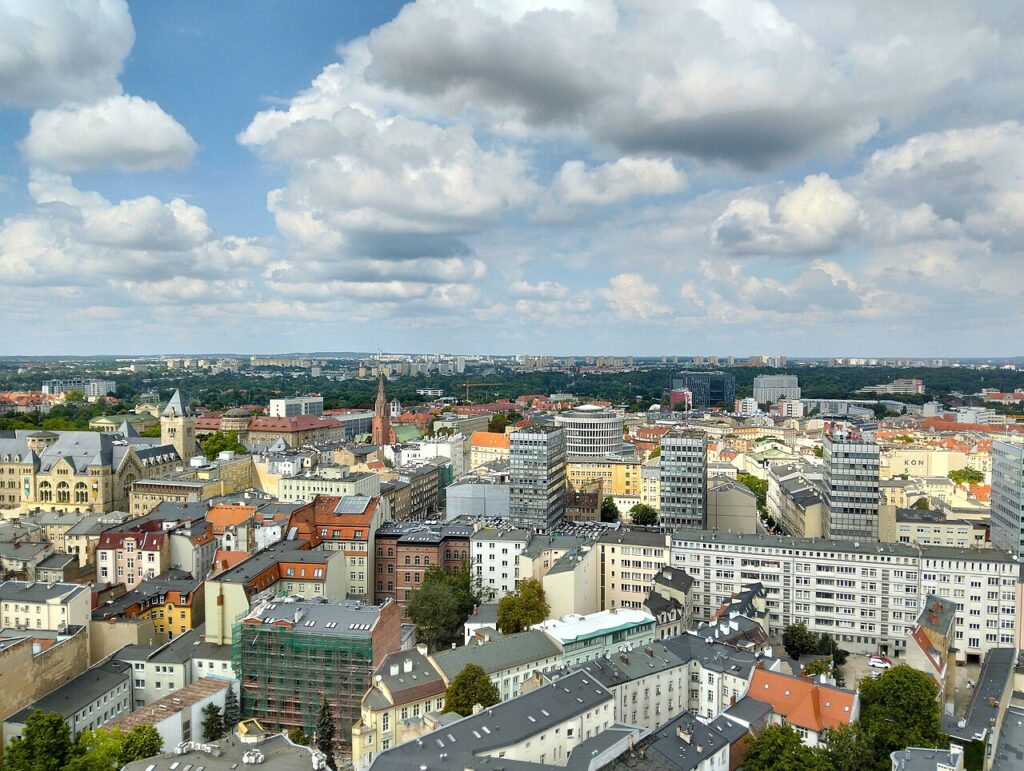
They tell the story of how the city rebuilt itself after destruction by experimenting with new ideas and how buildings adapt to changing urban spaces while developing their own character and becoming a beloved landmark in Poznań’s panorama.
For local people, these buildings are part of everyday Poznań. For visitors, they offer a reminder that the city’s history does not stop at the end of the 19th century.
Plan Your Poznań Architecture Walk
As part of a central city route, these buildings can easily be included in your next walk through the city’s architectural gems.
A suggested walk:
1. Plac Wolności
A historic urban square connecting several eras of Poznań’s development.
2. Okrąglak and Kwadraciak
Two contrasting examples of Polish modernism.
3. Święty Marcin Street
A street where historic buildings, university life and regeneration projects meet.
4. Imperial Castle
A reminder of Poznań’s early 20th-century ambitions.
5. Bałtyk and modern Poznań
A contemporary continuation of the city’s architectural experimentation.
The Buildings That Tell Poznań’s Modern Story
Okrąglak and Kwadraciak may not have the age of Poznań Cathedral or the decorative richness of the Old Market Square, but they represent something equally valuable: the story of a city constantly changing.
These two buildings show that Poznań’s architectural identity is not frozen in the past. It is a living collection of ideas, memories and different visions of what a city can become.
Next time you walk through central Poznań, look up. Some of the city’s most interesting stories are hiding in plain sight.
Source Click here to find out more intriguing stories from Poznań!