
Few places in Poznań attract as many admiring glances as the Proserpine Fountain. Set just metres from the colourful merchant houses and the Renaissance Town Hall in the heart of Stary Rynek, it is a familiar meeting point, a favourite backdrop for photographs and one of the city’s most treasured works of public art.
Thousands of people pass it every day, yet many know little about the story carved into its sandstone or the local legend that has become part of Poznań’s folklore. Although the fountain’s history can be traced back to municipal records, generations of locals have told a very different story about a wealthy widow named Petronela, a young stonemason, and a marriage that would end in tragedy.
It is this blend of documented history and storytelling that makes the Proserpine Fountain one of the most fascinating landmarks in Poznań.
The Oldest Surviving Fountain in Stary Rynek
The Proserpine Fountain (Fontanna Prozerpiny) is the oldest original fountain in Poznań’s Old Market Square. Commissioned by the city council in 1758 and completed in 1766 by sculptor Augustyn Schöps, it replaced an earlier public well that had supplied water to traders and residents for generations.
Centuries ago, wells occupied each corner of the market square, serving a practical purpose long before they became decorative landmarks. As Poznań grew into one of the Polish-Lithuanian Commonwealth’s leading trading centres, these wells evolved into elaborate fountains inspired by classical mythology.
Today, the Proserpine Fountain is unique. Although visitors can also admire the Apollo, Mars and Neptune fountains around the square, those are modern reconstructions based on historical designs. Proserpine is the only original eighteenth-century fountain to have survived.
Its survival makes it one of the most authentic reminders of the city’s Baroque heritage.
A Story Carved in Stone
The sculpture depicts the Roman myth of Pluto abducting Proserpine, daughter of Ceres, the goddess of agriculture.
According to mythology, Pluto carried Proserpine into the underworld, leaving her mother heartbroken. As Ceres mourned her daughter, crops failed and the earth became barren until Jupiter brokered a compromise with Pluto, allowing Proserpine to spend part of each year on Earth and part in the underworld. The changing seasons were said to follow her annual journey.
Schöps captured the dramatic tale in swirling Baroque forms that draw the eye from every angle. Around the basin, reliefs representing earth, air, fire, and water sit alongside the coat of arms of Poznań, linking classical mythology with the city’s civic identity.
The Legend of Petronela
Like many of Poznań’s oldest landmarks, the Proserpine Fountain has inspired stories that have outlived the generations who first told them.
According to local legend, a wealthy widow named Petronela fell in love with a handsome young stonemason’s apprentice. Despite their significant age difference, the pair married, though the relationship was never destined to be a happy one.
Before long, the young apprentice fell in love with a woman closer to his age. When Petronela discovered the affair, she accused her husband of attempting to poison her and brought the case before the town court.
The judges found no evidence of the alleged crime. Instead of imposing a severe punishment, they are said to have ordered the apprentice to create a fountain at his expense.
Choosing a subject that reflected his own unhappy circumstances, he sculpted the story of Proserpine, a young woman forced into a life she had not chosen.
The legend concludes with a familiar moral. Petronela dies alone, while the apprentice eventually marries the woman he truly loves. The fountain stands as a reminder that love cannot be bought, regardless of wealth or status.
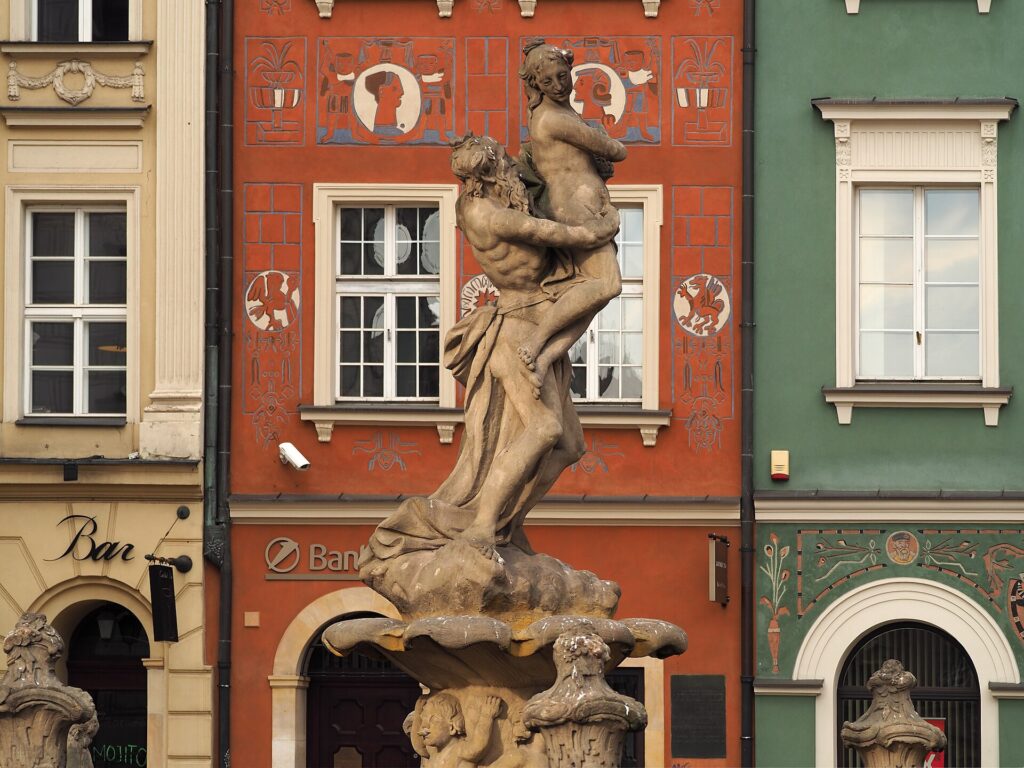
History Tells a Different Story
As captivating as the tale may be, there is no historical evidence that Petronela existed or that the fountain was commissioned as the result of a court judgment.
City records instead confirm that the Proserpine Fountain was a civic project commissioned by Poznań’s authorities in the mid-eighteenth century and executed by Augustyn Schöps between 1758 and 1766.
A Familiar Landmark for Every Generation
The Proserpine Fountain has quietly observed centuries of city life. It has witnessed bustling market days, royal processions, wartime destruction, Christmas markets, festivals and countless everyday moments in one of Poland’s most beautiful public squares.
More recently, it stood behind protective fencing during the extensive restoration of Stary Rynek before returning to the centre of a revitalised square where residents and visitors once again gather beneath the Town Hall.
For many locals, it is simply part of the landscape. Yet pausing for a closer look reveals a monument layered with mythology, craftsmanship, civic history and folklore.
Whether you choose to believe the story of Petronela or the records preserved in the city archives, the Proserpine Fountain remains one of those rare places where history and imagination continue to share the same space.
Source Discover the story behind one of Poznań’s most fascinating buildings!